An interpretive portrait drawn from Kord’s surviving doctrine and storm imagery; the god has not appeared directly.
Doctrine: strength proved through courageous action; endurance in adversity; honest competition; freedom from cowardice and restraint. Storm and thunder imagery accompany the faith.
Karl named Kord during the Trial of Voice, and the trial answered by deepening his voice with a resonance like distant thunder. He later called upon Kord to produce revealing light before the basilisk ambush, to repel the wraiths beyond the forbidden doors, and to cure the living water-passage creature after Toby infected it on Day 12. Halen also carried—and later lost—the Belt of Kord.
An interpretive portrait based on Gond’s doctrine of invention, craft and practical knowledge.
Doctrine: invention, skilled craft, smithing, construction and the disciplined transformation of ideas into working things. Making and practical knowledge are sacred acts.
The party sheltered in a forgotten chamber marked by tools, gears and ordered craftsmanship. The surrounding demiplane still contained an astrolabe and self-operating machinery, although no direct manifestation of Gond appeared.
An interpretive pantheon portrait. Jergal was named in the surviving Day 8 summary but no manifestation or servant was witnessed.
Pantheon: Jergal belongs to the Faerûnian pantheon. Known as the Scribe of the Doomed and formerly the Lord of the End of Everything, he surrendered much of his authority over death to Bane, Bhaal and Myrkul. In later ages he serves as the austere seneschal and record-keeper of the lawful dead beneath Kelemvor.
Doctrine: death is inevitable and must be recorded without passion or favour. Every mortal life ends, every name enters the final ledger, and the proper accounting of the dead preserves the order between life, death and judgement.
The Day 8 source briefly names Jergal alongside an incident involving Beast Magic, but supplies no complete account. The archive therefore records him as discussed lore rather than a god or avatar encountered by the party.
The avatar encountered at the Library of All Knowledge: an ordered shape barely containing a hungry, formless presence.
Doctrine: hunger, dissolution, submission to unknowable power and reverence for beings rejected by ordered creation—especially oozes and other shapeless things. The faith offers favour capriciously rather than through justice.
An avatar of Ghaunadaur guarded the threshold of the Library of All Knowledge. When Asuran challenged its command to leave, it shed a strange divine symbol at his feet before the party was expelled. This is the first named divine avatar the party directly encountered.
An interpretive portrait based on the troglodytes’ funerary rites, sacred water and ancestral duty; Semunyae was not directly witnessed.
Doctrine: death as passage, the release of souls and the proper ending of undead existence. The troglodytes’ surviving rites connect the faith to tombs, ancestral duty and sacred water.
Troglodytes in the primordial swamp spoke of Semunyae as their lost god of death. In the ziggurat, a dead high priest’s spirit remained trapped because his god was absent; the party’s intervention finally released him. The spelling and doctrine here preserve the faith as encountered in the campaign.
An interpretive vision of Thardar through the nature-bound essence preserved in dwarven gems.
Doctrine: life and growth rooted in stone; healing; patient cultivation; and the balance between deep earth and the living world above.
Deliberate sacrifice: Thardar’s unicorn testified that he willingly gave his life so his essence could remain useful after magic disappeared. Dwarven artificers converted that essence into charged gems. His temples and clerics had already vanished long before the wider Waning, placing his sacrifice earlier than the general collapse.
The gems: Karl’s red gem and the unicorn’s yellow gem preserve different expressions of Thardar’s power. The yellow gem fuelled the unicorn’s innate abilities without draining its life; it was later used to release part of Thardar’s essence into the land before passing to Tanner.
Separate from Telchur: Although both gods appear to have chosen self-sacrifice, the unicorn said their purposes were different and rejected the theory that they had built the sanctuary together.
A visual interpretation of the ancient door symbol; no physical form or divine identity was witnessed.
Doctrine: cultivation, fertility, settled earth and the sustaining bond between soil and mortal life. The surviving symbol predates the familiar pantheon.
A carved door in the earth demiplane bore this ancient sign. The party identified its concerns but not the power’s name, and could not establish whether it represented a god, a primordial force or a forgotten cult.
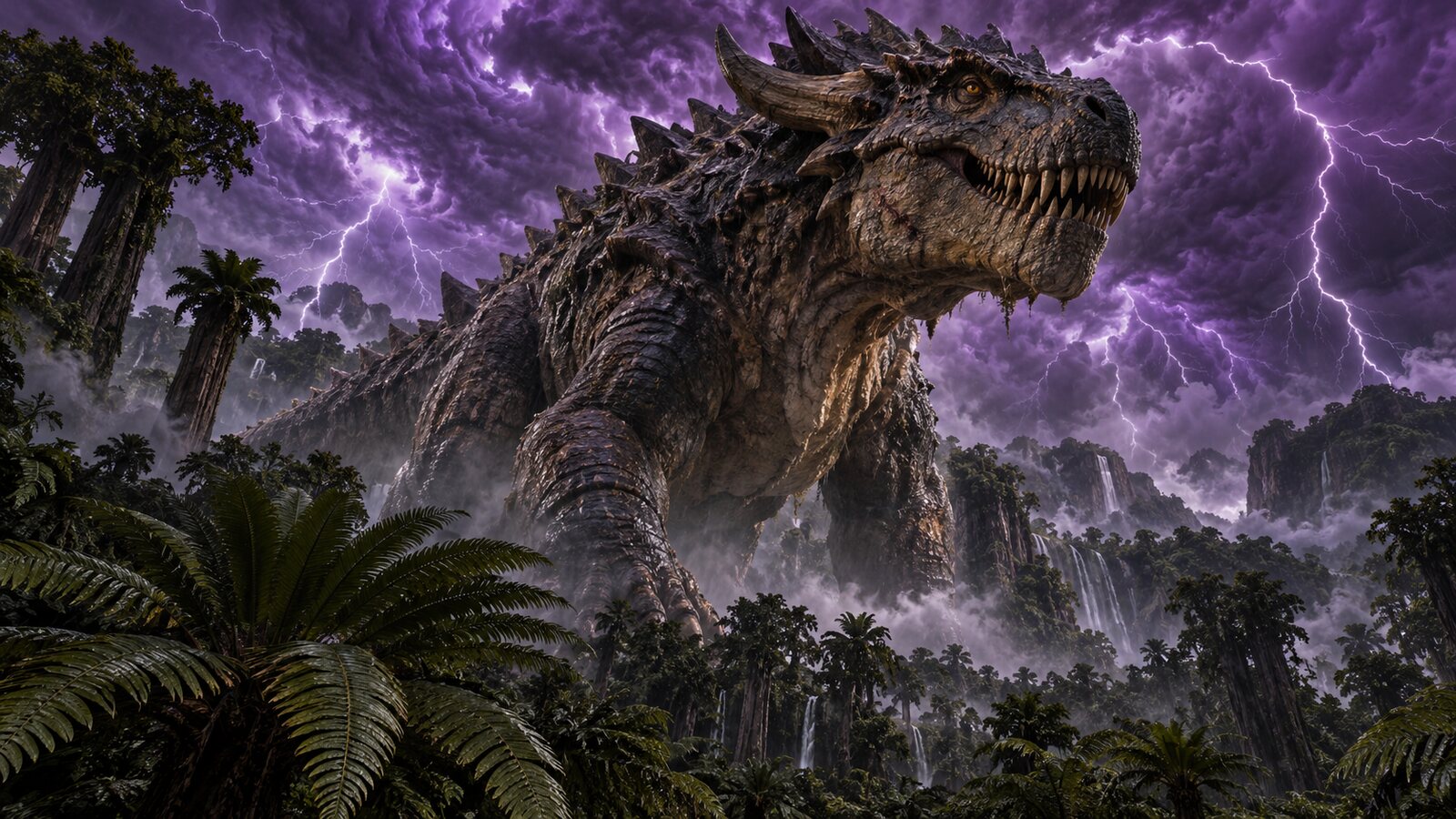
Utabo as witnessed in the ancient jungle: a colossal saurian power advancing towards an unknown titan.
Known sphere: dinosaurs, primeval beasts and the dominion of the oldest living world. No formal creed, worshippers or holy symbol were identified during the encounter.
The party recognised Utabo as a demigod and god of dinosaurs when he emerged beneath the purple storm. Unlike the archive’s interpretive portraits, this entry records a directly witnessed divine being. Utabo did not address the party; he advanced towards a dragon-demon titan and met it in physical battle.
The diminished two-headed avatar encountered in Laogzed’s hidden shrine beneath the frozen surface.
Known sphere: hunger, ritual consumption and the brutal appetites preserved by Gut Ripper’s barbarian cult. The exact surviving doctrine remains fragmentary.
Avatar encountered: The party met a bloated, two-headed reptilian manifestation—not Laogzed in full, but a surviving divine fragment able to reason, bargain and bestow supernatural marks. After Toby’s planar-knowledge check, the party collectively proposed feeding it the dead elemental’s remaining blood so it could open the portal and allow the surviving elemental to be sent through. Kev was absent, and the other players were controlling Toby during this scene.
The avatar demanded flesh before it would fully awaken. Halen ate a bite of Gut Ripper’s corpse. Halen already carried the Mark of Jergal, and Asuran also bears that mark; Laogzed placed its own mark alongside Halen’s existing one. The avatar stated that Laogzed had been lost even to its own avatars for 142 years.
No avatar was confirmed; the party invoked the ancient power represented by the pack.
Sphere: wolves, predation and the law of the pack. Tanner accepted the sabre-toothed tiger on the Wolf Lord’s behalf through a form of worship older than named gods.
WINTER GOD · IDENTIFIED DAY 25
Telchur
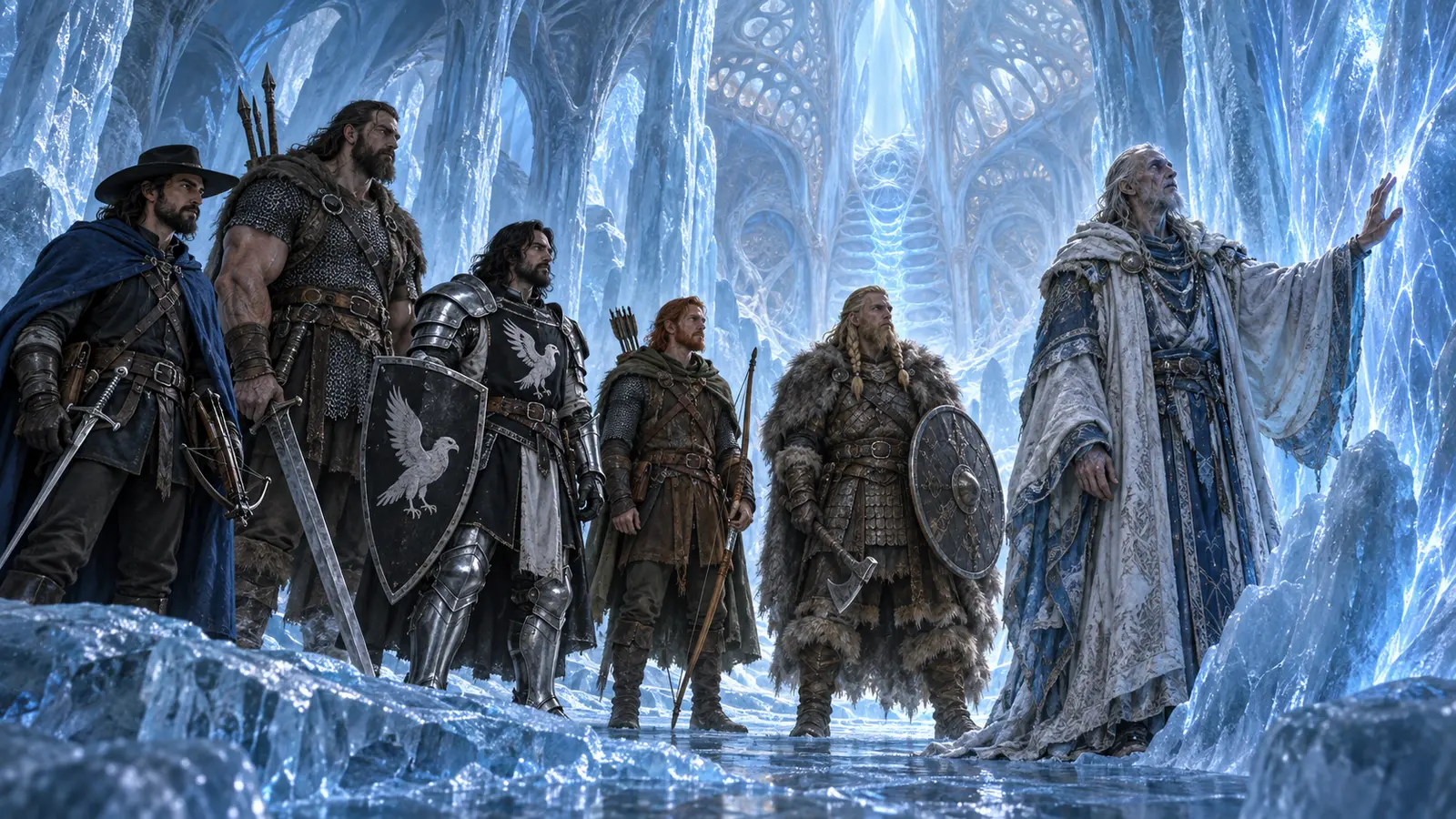
An interpretive vision of Telchur as the Frost King, accompanied by a winged bull of living ice.
Sphere: winter and cold. Telchur is neutral or chaotic neutral. His symbol is a leafless tree in a field of snow; he is depicted as a gaunt man with dark eyes and a beard of icicles.
Farmers and people seeking relief from winter’s chill worshipped him. His champions called him the Frostfather and gathered their communities’ menhirs inside his ice demiplane for a final ritual.
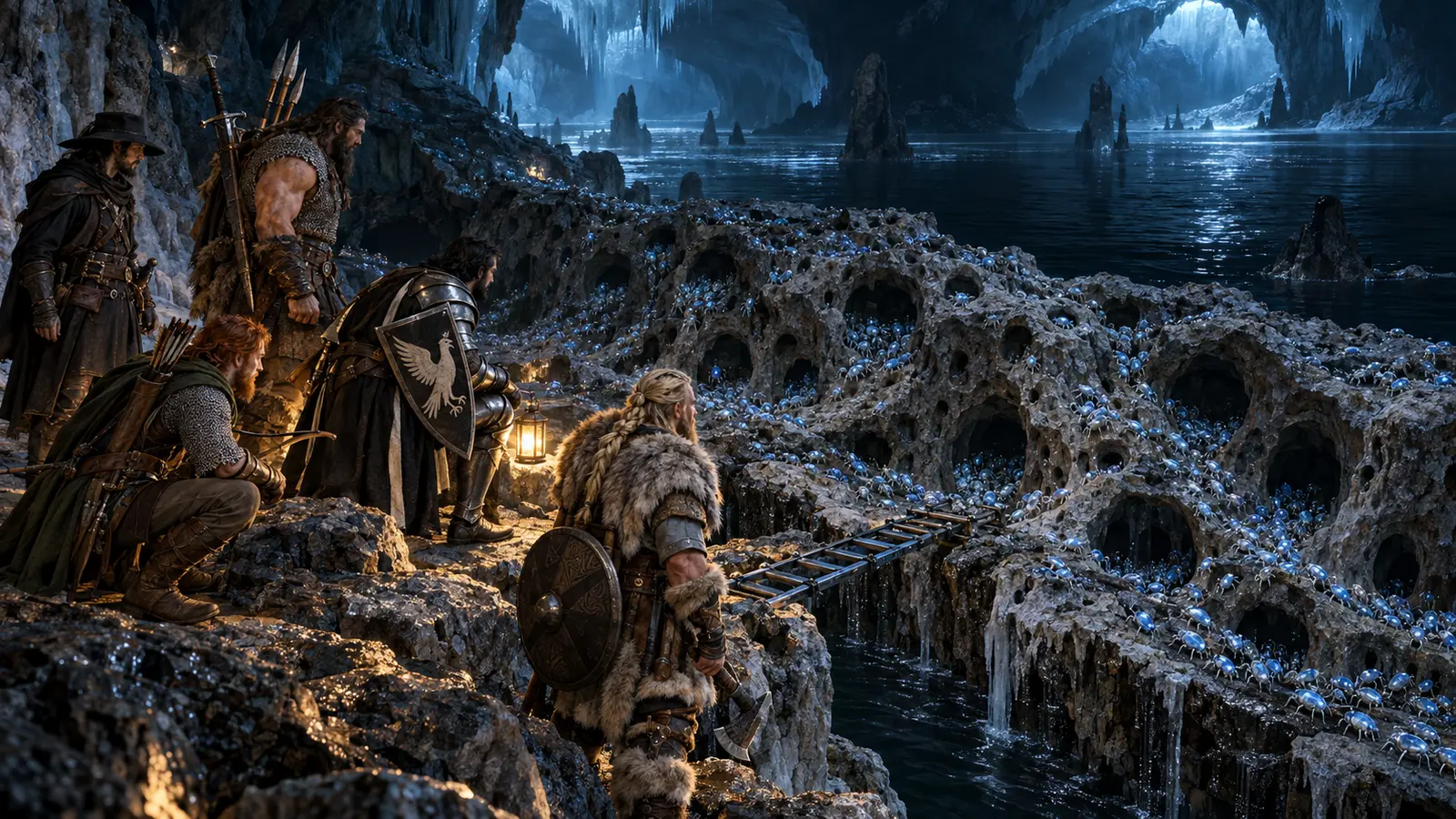
The sanctuary: Telchur’s glacier contains a deliberate refuge and containment complex rather than indiscriminate ice alone. Eight concealed cells preserved magical creatures, with a remorhaz supplying the cold that linked the system. A martial guardian, provisions and protected chambers survived within it.
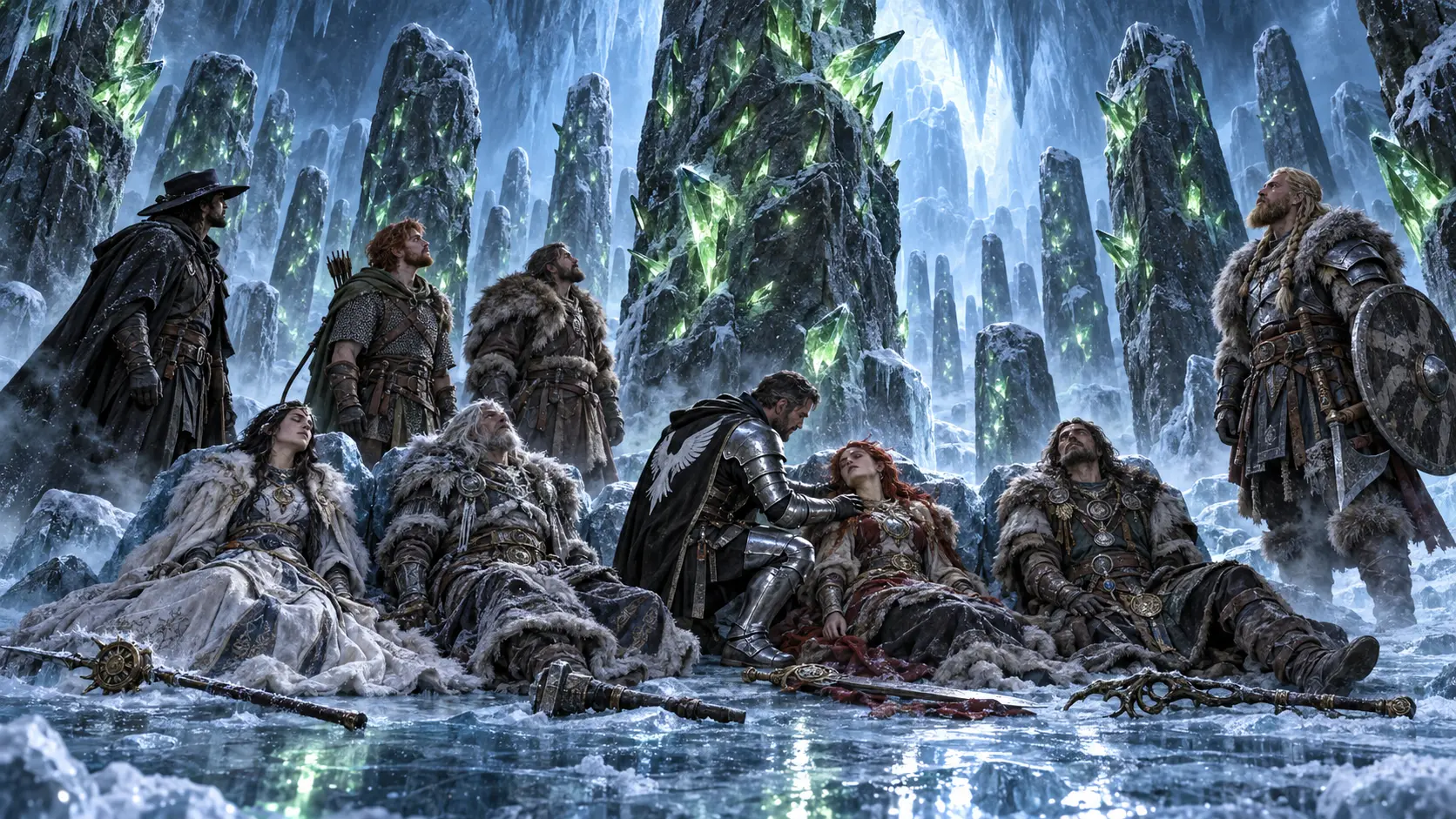
The remains were fused into the living glacier rather than lying there as ordinary treasure. The party observed them without touching, cutting free or removing anything.
Preserved in place: Asuran recognised the divine character of the ice-coloured forms, but neither he nor any companion handled them. No piece of the remains was collected; the site was left intact for Telchur’s priest.
The White Corpse: The last priest first described Telchur as slain, but the later answer given in his name refined that truth. At the edge of death Telchur transformed into the vast glacier and remains faintly alive within it. Its crystalline spark still heals, shifts, remembers and dreams. The creatures and refugees inside it live within the changed body of a god, not an ordinary ice demiplane.
The last priest can steer internal routes through prayer, but discovered that the divine body’s passage to the Summerlands had been blocked.
The arrested journey: A powerful planar barrier prevented the White Corpse from reaching the Summerlands. Its exits sealed when the journey began, conventional teleportation fails within it, and the body continues moving across the Prime Material instead.
The road to the Heart: Five regions form the internal path: Mouth, Refuge of the Forgotten, Crystal Labyrinth, Blood Veins and Heart. Shards open the thresholds between them. The Winter Knight’s original belief that all five would unite as a boon has been superseded by the divine answer: Telchur’s guarded essence must be ritually released or redirected so the White Corpse can complete its passage.
The road contains five named regions, although the avatar revealed six guarded visions whose precise locations remain unknown.
The avatar’s answer: Prayer before the neutral fertility idol awakened a divine intermediary speaking in Telchur’s name. The company chose restoration over escape and learned that Telchur’s remaining divinity had prevented the body from crossing the planar barrier. The White Corpse has wandered the mortal world for roughly eighty-five years since that failed passage.
Essence and ritual: The surviving essence is defended at six foreseen sites. A shard is a raw piece of Telchur and can be shaped by communal prayer, drawing upon his aspects of air, cold, chaos, storms, strength and winter. Removing the essence without the proper rite risks killing what remains of him.
Relationship to Thardar: Both gods appear to have sacrificed themselves so power or life could survive the Waning, but the unicorn denied that they had followed a shared plan. Their similar fates do not establish an alliance.
The plague god’s shattered essence remained embedded in Telchur’s sanctuary.
Sphere: plague, pestilence, disease, decay, rust and madness. Morgion is a neutral-evil power worshipped secretly by those who spread sickness and desolation.
Telchur’s champions remembered Morgion being defeated within the sanctuary. Part of his being exploded into the green divine fragments that later infected the demiplane’s animals and frozen defenders. “The Black Wind” is confirmed; the automatic transcript’s additional title “Master of Thieves” remains unreliable and is not treated as canon.
WATER GOD · THEORISED FROM LATER EVIDENCE
Adad
The salt water beneath the glacier suggested Adad’s influence, but no avatar, servant or confirmed sign of the god was witnessed.
Known sphere: water, rain, storms, strength, air and chaos. Adad is remembered as a chaotic-neutral power whose manifestations take a man-like form of living water, flowing into a serpentine lower body and bearing a great warhammer.
Salt water beneath the advancing glacier brought Adad’s name to mind. He has no known authority over winter or ice, so the party’s working theory is that another power may have redirected part of his essence to help create the divine glacier. This remains unproven.
The unicorn’s testimony connected dwarven gemcraft directly to Thardar’s voluntary sacrifice.
The unicorn had received its yellow gem from the dwarves. The gem powered its innate magical abilities without forcing it to consume its own life force, demonstrating how divine reserves can substitute for the world’s lost magic.
It had already expended much of the gem to release Thardar’s essence into the land. The finite power that remained was entrusted to Tanner, a skilled leatherworker who secured the stone in his fur cloak’s clasp. Worn there, it gave him a more compelling and commanding presence while strengthening the conviction with which he could oppose hostile undead.
Divine witnesses
Servants and signs
The Celestial Watcher that answered Karl on Day 11 was not identified as a god. It warned that the old gods no longer listened, while older and hungrier beings might answer careless prayer. The red, lime-green, orange and exhausted grey gems may preserve divine or supernatural power, but their full identities are not yet known.
◆
DIVINE ESSENCE · DAYS 1–13
The Coloured Gems
The red gem began as an unresolved relic. By Day 13, the party had evidence that at least some gems contain fragments or charges associated with lost divine powers.